THE DISTRIBUTION BULLETIN ISSUE #53
By Peter Broderick
Welcome to our crash course in Dynamic Distribution!
Keith Ochwat, of Show&Tell, and I have designed this course to empower independent filmmakers who are facing both daunting challenges and unprecedented opportunities.
Our course has four sections:
Dynamic Distribution #1 - The Strategy
Dynamic Distribution #2 - The Tactics
Dynamic Distribution #3 - Breakthroughs
Dynamic Distribution #4 - More Breakthroughs
Each section will be available as a separate Distribution Bulletin.
We recommend you read them in order.
- Peter Broderick and Keith Ochwat
======================================================
DYNAMIC DISTRIBUTION #1
THE STRATEGY
You need a new strategy to survive and prevail in this Dark Age of Distribution.
However bad you think things are, they’re worse. Docs aren’t working in theaters. Streamers are acquiring few docs. Sales of docs at festivals are in steep decline. TVOD revenues are vanishingly small. Foreign sales of docs are dismal. The Old World of Distribution has cratered. The days of magical thinking are over.
It's high time for a new strategy. Dynamic Distribution is the best way to survive the Dark Age and succeed in the New World of Distribution.
DYNAMIC VS. PASSIVE DISTRIBUTION
Dynamic Distribution enables filmmakers to keep overall control of their distribution. Passive Distribution requires filmmakers to give away control of their distribution. For many years, filmmakers have ceded full control of their films to distributors for 5, 7, or more years. This is no longer a viable approach. Countless filmmakers have learned this lesson the hard way.
Today it is essential to maintain control to maximize your distribution. This is central to Dynamic Distribution. With control, filmmakers can split their distribution rights among distributors and retain rights they can handle better themselves.
Control also empowers filmmakers to design strategies customized to their goals, core audiences, and partners. Customized strategies work far better than formulaic strategies, which too often involve throwing films against the wall and seeing if they stick. Films that don’t stick get little or no more support from distributors.
The other major benefit of retaining control is that it facilitates flexible release strategies that can be refined stage by stage based on results.
Passive distribution is backward looking, relying on outdated tactics that no longer work. Dynamic distribution is forward looking, utilizing the latest approaches that are being proven on the frontiers of distribution.
Here are five opportunities of Dynamic Distribution contrasted with the basics of Passive Distribution: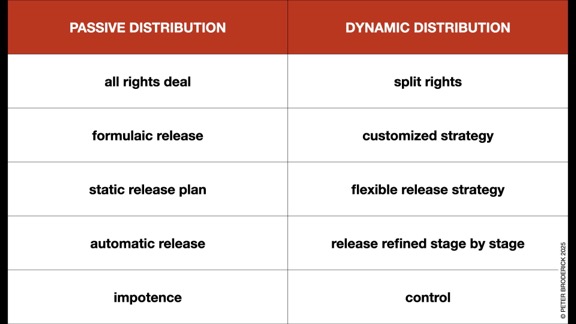
Dynamic Distribution is not a theory. It is the practice for filmmakers who are blazing fresh trails in the New World of Distribution (see Dynamic Distribution #3 - Breakthroughs and Dynamic Distribution #4 - More Breakthroughs, coming soon).
Keith and I have helped filmmakers maximize the distribution of more than 2000 films. We have seen first-hand how rapidly documentary distribution has changed. As Passive Distribution has withered, Dynamic Distribution has blossomed.
FUNDAMENTALS OF DYNAMIC DISTRIBUTION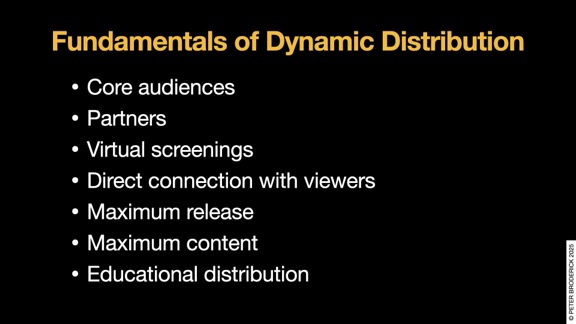
Here are seven essential principles of Dynamic Distribution:
CORE AUDIENCES – the first step in designing a Dynamic Distribution strategy is identifying and connecting with your film’s core audiences. Researching these audiences and reaching out to them will enable you to test their interest and highlight potential partner organizations. Some films will succeed by first connecting with core audiences and then expanding to the general audience. Films that ignore core audiences and just focus on the general audience have a much smaller chance of succeeding.
PARTNERS – the second step is finding partners that will support the film in key ways. These can include nonprofits, companies, government agencies, foundations, membership organizations, and religious institutions.
- Some partners will only provide in-kind support, which is critical to building awareness of the film and its importance. Without achieving a critical level of awareness, excellent films will fail.
- Other partners will be able to provide financial and additional resources needed to power a distribution campaign.
- Many partners have annual meetings. Screening a trailer in a plenary or showing the whole film will create wide awareness among attendees and attract partners.
VIRTUAL SCREENINGS – are a powerful new tool that empowers Dynamic Distribution. They can generate valuable feedback during editing, attract partners, foster word of mouth, help build an audience around a film, and raise money to support its distribution. Virtual events can be private (limited to the members of an organization) or public (open to a national or global audience).
DIRECT CONNECTIONS WITH VIEWERS - are central to Dynamic Distribution. Virtual and in-person events will enable filmmakers to communicate directly with viewers in all stages of distribution and learn from their feedback how best to frame and finalize the film itself. These connections with viewers will also enable filmmakers to build a personal audience they can take to future films.
MAXIMUM RELEASE - Passive Distribution compresses a film’s release into a very short period from premiere to TVOD. Dynamic Distribution enables filmmakers to make the most of every distribution window. It allows them to control the length of each window, lengthening windows that are going well and shortening windows going poorly.
MAXIMUM CONTENT – Dynamic Distribution facilitates the use of multiple versions. An 86 minute documentary feature should also have a 56 minute version that will work on PBS and in classrooms, and a 15 minute version that can be shown as a keynote or in seminars.
EDUCATIONAL DISTRIBUTION – this will be the most important window for many documentaries. It will help them maximize impact and revenue. Docs can be shown in colleges courses, graduate schools, and high schools. They can also be used by nonprofits, government agencies, and companies for teaching and training. The more widely a film is seen in educational distribution, the greater will be its awareness in subsequent windows and the larger its life. Passive Distribution often skips educational distribution.
Next we will focus on the tactics of Dynamic Distribution and highlight Pre-distribution.
======================================================
Keith and I will follow up shortly with Section 2 of our Dynamic Distribution course. Stay tuned!
© 2025 Peter Broderick